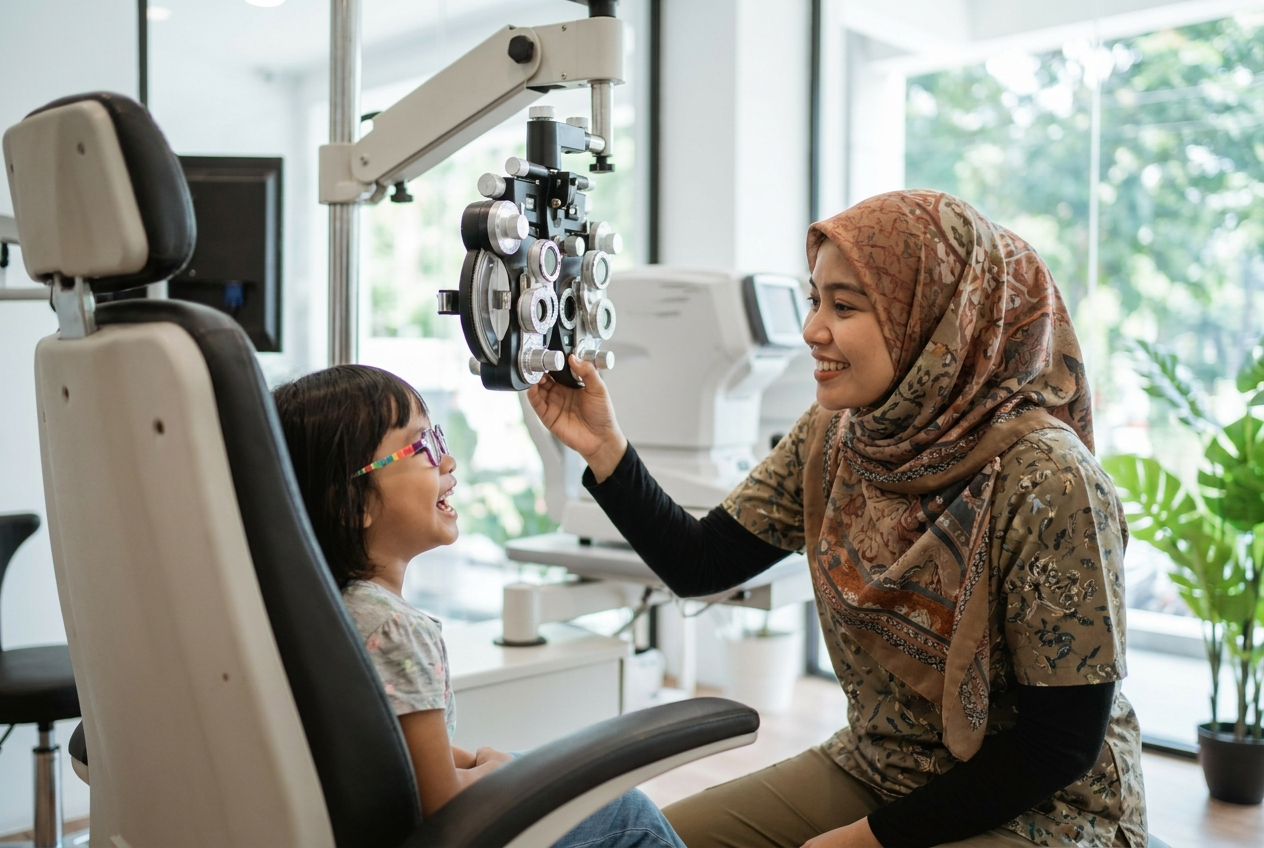
A clear, evidence-based guide to myopia (short-sightedness): the risk factors, why every dioptre increase matters, the best myopia management available, and the plan we build together.
Interactive Assessment
Check your child's myopia risk
Select the factors that apply. This mirrors the assessment we use in clinic. It is a starting point for conversation, not a diagnosis. It is an educational checklist, not a validated risk calculator, and does not calculate a child’s probability of developing or progressing in myopia.
Risk Score
Additional Factor: Emerging Evidence
Binocular Vision Anomalies
Children with esophoria at near, high AC/A ratio, reduced accommodative response, or intermittent exotropia may have elevated risk of developing myopia. Recent IMI and MPRAS literature supports including this factor, though it was not part of the original BHVI 2020 scoring card. It is assessed during every comprehensive examination at Menara Optometry.
Mutti et al., 2006; Gwiazda et al., 2005; Manoharan et al., 2023 (MPRAS, Brien Holden Eye Research Centre)
Additional Factors: Evidence Not Yet Conclusive for Progression
These factors are clinically relevant and assessed during examination, but their direct role in accelerating progression (as opposed to triggering onset) is not yet conclusive. They are excluded from the score above but noted for clinical awareness.
Time Outdoors (<90 min/day)
Strong evidence supports outdoor time for delaying myopia onset, but evidence for slowing progression once myopia has developed remains mixed. The Menara protocol, informed by IMI (Gifford et al., 2019) notes "considerable evidence to support delaying onset, but mixed evidence for slowing progression." Still recommended as a safe, zero-cost habit.
Jonas et al., 2021 (IMI Prevention); Menara protocol, informed by IMI (Gifford et al., 2019)
Near Work Habits
Reading at close distances (<20cm) and prolonged continuous near work (>45 min) are associated with myopia onset. Their independent contribution to faster progression is less clearly established, though near work remains a modifiable behaviour worth addressing.
Ip et al., 2008; Huang et al., 2015; IMI Risk Factors (Morgan et al., 2021)
Binocular Vision Anomalies
Near esophoria, high accommodative lag, and intermittent exotropia have been associated with faster progression in some studies. However, the STAMP study (Berntsen et al., 2012) found the PAL treatment effect was not greater in children with higher lag, challenging the pure lag theory. IMI notes "conjecture exists as to whether accommodative errors are a feature rather than a cause of myopia."
Gwiazda et al., 2004 (COMET); Berntsen et al., 2012 (STAMP); Gifford et al., 2019 (IMI)
Adapted from the Brien Holden Vision Institute Myopia Management Online Course (2020). Used at Menara Optometry Mid Valley.
The Long View
Myopia is not just thicker glasses
Every dioptre a child gains raises their lifetime likelihood of sight-threatening eye complications. This is why we act early, and why slowing it matters.
+67%
higher prevalence of myopic maculopathy
per added dioptre (associated)
−40%
lower likelihood of myopic maculopathy
if final myopia is 1D lower (estimated)
Bullimore & Brennan, Optom Vis Sci 2019, 21,000 patients
What high myopia can lead to
Tap each condition to see how it affects sight, and how the risk climbs with myopia (odds compared with a non-myopic eye; pooled estimates, not an individual child's absolute chance).
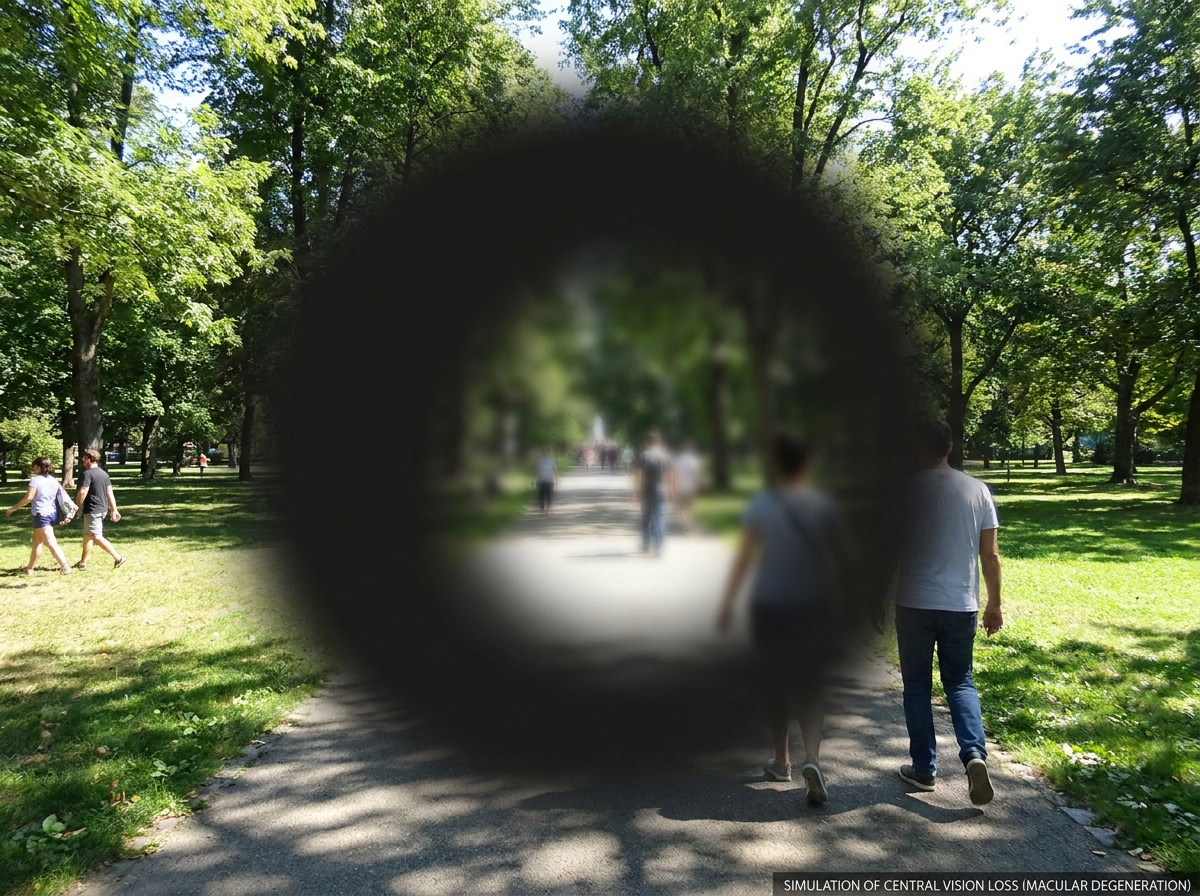
Myopic Macular Degeneration
Loss of the sharp, central vision
845×higher odds (high myopia)
Illustrative simulation of central vision loss, a blurred or blank spot in the middle of sight. Prepared by Muhammad R; vision effects per National Eye Institute.
13.6×
Low <−3D
72.7×
−3 to −6D
845×
High ≤−6D
Damage to the macula robs a child of the detailed central vision needed to read, recognise faces and drive. In high myopia the odds rise to 845× a non-myopic eye. It is the leading cause of irreversible vision loss in myopia.
Retinal Detachment
A dark curtain across the vision
12.6×higher odds (high myopia)
Illustrative simulation prepared by Muhammad R. The AAO describes vision "partially or totally blocked by dark or blurred shapes… like a shadow or curtain." A medical emergency.
3.2×
Low
8.7×
Moderate
12.6×
High
A longer, more stretched myopic eye is far more likely to tear and detach at the retina, a sudden and sight-threatening emergency needing urgent surgery. Risk reaches 12.6× in high myopia.
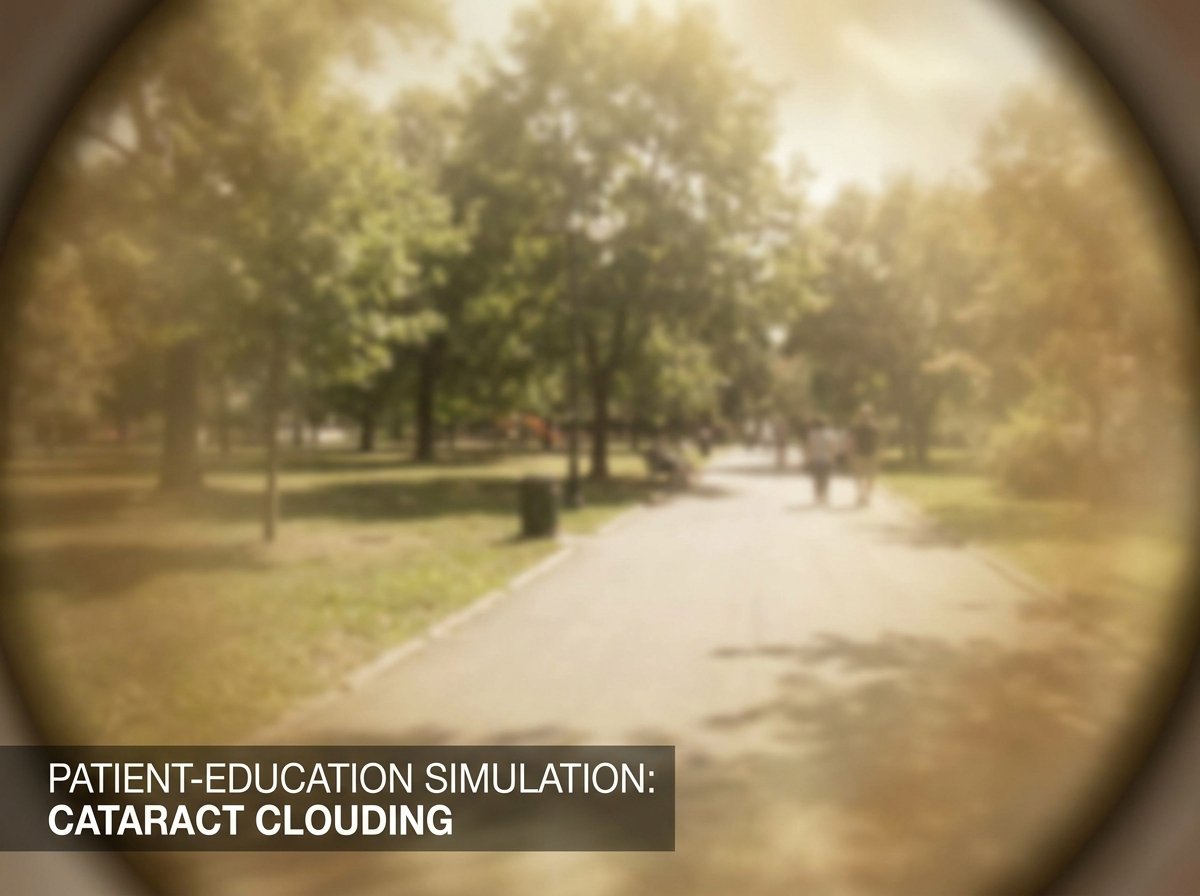
Posterior Subcapsular Cataract
Cloudy, dimmed, faded vision
4.6×higher odds (high myopia)
Illustrative simulation prepared by Muhammad R. A clouded lens dims, blurs and yellows the whole scene. Vision effects per National Eye Institute.
1.6×
Low
2.6×
Moderate
4.6×
High
Myopic eyes develop cataract earlier in life, clouding vision at up to 4.6× the risk in high myopia.
Prof. Ian Flitcroft, International Myopia Institute
What this means for your child
If your child's myopia is currently −2.00D and we can slow progression so they reach −4.00D instead of −6.00D by adulthood, we would see about 64% lower modelled likelihood of myopic maculopathy (the ~40% per dioptre compounds rather than adds; a population-level estimate, not an individual guarantee).
This is not about thicker glasses. It is about protecting their sight for life.
Evidence-Based Options
What actually slows myopia
Based on published randomised controlled trial data. The numbers below are a list, not an efficacy ranking. ✦ marks options available at Menara Optometry.
Why standard single-vision lenses are not enough
Single-vision (SV) spectacles correct your child's vision clearly at the centre, but they create hyperopic (long-sighted) blur in the peripheral retina. This peripheral defocus is thought to be one signal that encourages the eye to grow longer. Management lenses replace it with myopic defocus instead, and trials show children in these lenses progress less than those in single-vision lenses. Single-vision lenses correct vision but are not designed to slow progression.
In clinical trials, children in SV lenses consistently showed faster progression than those in myopia-management lenses (DIMS 0.44 D and HAL 0.80 D more, each over two years).
Berntsen et al., IOVS 2013; Lam et al., Br J Ophthalmol 2020; Bao et al., JAMA Ophthalmol 2022; Smith III et al., IOVS 2005, 2009 (primate models)
Eye elongates How peripheral defocus is thought to affect eye growth
1. The centre of vision focuses sharply on the retina (green). 2. The edges focus behind the retina (red arrows): peripheral hyperopic defocus. 3. This blur is a local signal, from the retina to the sclera, that is thought to signal the eye to grow longer, which can worsen myopia over time.
% = average myopia slowing compared with standard single-vision lenses.✦ = available at Menara
Tap any option for the full breakdown (axial length and prescription) and the evidence. Figures come from separate trials with different designs, durations and participants, and are not a direct comparison.
Essilor Stellest ✦ Available
Spectacle lens (H.A.L.T.)
67%
slowing
Aspherical lenslets create a zone of peripheral myopic defocus that signals the eye to slow its growth.
Axial length
~60%
Prescription
~67%
Manufacturer-reported figure. The headline shown is the prescription (SER) figure; the axial figure is in the breakdown above. Over 2 years vs single-vision lenses, in children who wore them at least 12 hours a day. Bao et al., JAMA Ophthalmol 2022. · Essilor Stellest (official)
A honeycomb pattern of +3.50D defocus segments slows the eye's growth.
Axial length
~60%
Prescription
~59%
Manufacturer-reported figure. The headline shown is the axial-length figure; the prescription figure is in the breakdown above. Over 2 years vs single-vision lenses, in participants who completed the study. Lam et al., Br J Ophthalmol 2020 (3- and 6-year follow-up: 2022; Sci Rep 2023).
FDA-approved for myopia control in children aged 8-12 at the start of treatment (-0.75 to -4.00 D). Manufacturer-reported figure. The headline shown is the prescription (SER) figure; the axial figure is in the breakdown above. Over 3 years vs a single-vision 1-day lens. Chamberlain et al., 2019.
Overnight corneal-reshaping lenses that also create peripheral myopic defocus. Efficacy is judged by axial length, because they change daytime refraction by design.
Axial length
~43% less
Prescription endpoint
Not used to assess efficacy
Efficacy is measured by axial length only, because ortho-K reshapes the cornea and changes daytime refraction directly. In the two-year randomised ROMIO trial, axial elongation was 0.36 mm with ortho-K versus 0.63 mm with single-vision spectacles, about 43% less. A 2015 meta-analysis of seven controlled studies (two randomised, five observational) reported a similar figure of about 45% (moderate-certainty evidence). Overnight lens wear needs professional fitting, strict hygiene and regular follow-up, and carries a risk of eye infection. Cho and Cheung, ROMIO, IOVS 2012; Sun et al., PLoS One 2015.
Low-dose atropine (0.01% to 0.05%) Co-manage
Eye drops (co-managed)
VARIES
by concentration
A prescription muscarinic-antagonist eye drop. Effectiveness and side effects vary by concentration, and treatment is prescribed and monitored under medical co-management.
0.05% axial length
~51%
0.05% prescription
~67%
In the one-year, placebo-controlled LAMP trial, 0.05% atropine was associated with about 67% less prescription progression and 51% less axial elongation. Lower concentrations gave smaller effects (0.025%: about 43% and 29%; 0.01%: about 27%), and at 0.01% the axial-length effect was small (about 12%) and not statistically significant versus placebo in the one-year analysis. Concentration and monitoring are decided by the prescribing clinician, and individual results vary. Yam et al., LAMP, Ophthalmology 2019.
Other options worth knowing
These can help, but the evidence is smaller or based on shorter or single trials. We'll discuss them if they suit your child.
Progressive & bifocal spectacles ✦ Available
Spectacle lens
VARIES
by design
Standard spectacle designs that add reading power.
In one 3-year trial, executive bifocals (+1.50 add) slowed prescription progression ~39%, rising to ~51% with added base-in prism. The trial included children already progressing ≥0.50 D/year, so these figures don't represent all bifocal wearers. Standard progressive lenses have a smaller effect (COMET: 0.20 D difference over three years). Both trials used single-vision spectacles as the comparator. Cheng et al., JAMA Ophthalmol 2014 · COMET, Gwiazda et al. 2003
Multifocal soft contact lenses ✦ Available
Contact lens · +2.50 add (off-label)
Rx ~43% AL ~36%
A centre-distance daytime soft lens with a high +2.50 add.
Axial length
~36%
Prescription
~43%
Over 3 years vs single-vision contact lenses. The Biofinity Multifocal D lens studied in BLINK is marketed for presbyopia; its paediatric myopia-control use was off-label. BLINK: Walline et al., JAMA 2020 · official indication
EDOF lenses (extended depth of focus) ✦ Available
Contact lens
VARIES
by design
Daytime-wear EDOF soft contact lenses; replacement schedules vary by product.
Axial length
Varies by design
Prescription
Varies by design
Results depend on the specific lens. A one-year trial of SEED 1dayPure EDOF Mid +1.50 D reported approximately 59% less prescription progression and 49% less axial elongation, versus single-vision spectacles; earlier prototype designs reported ~26–32% (prescription) and ~25–27% (axial). Single or short trials. Manoharan & Verkicharla (SEED-LVPEI) 2024 · Sankaridurg et al. 2019
Standard correction
Standard single-vision lenses
Standard lens
Correction only
Corrects central vision only, and creates peripheral hyperopic defocus that can drive the eye to grow longer.
Single-vision correction is the comparator in many of the trials above, not a myopia-control treatment. Berntsen et al., IOVS 2013; Smith III et al., IOVS 2005.
About this guide. This guide covers the main options we currently offer or co-manage, plus a few relevant alternatives. It isn't a complete list, and we update it over time as new research and products emerge. An option not shown isn't necessarily unsuitable or unavailable; it may need a referral, have limited local access, or still be under review. Some newer approaches, such as repeated red-light therapy, show promise but aren't included here while their long-term retinal safety is still being studied. We'll recommend what fits your child after an assessment.
Working Together
The plan & everyday habits
How closely we monitor depends on your child's risk level. Menara follow-up protocol, informed by IMI Clinical Management Guidelines (Gifford et al., 2019).
Referral to TTDI Specialty Centre for annual axial length
Risk assessment & parent consultation
3-Month ReviewHigh-risk fast progressors
Visual acuity assessment
Refraction if vision has declined
Treatment compliance review
If progression is stable, next review extends to 6 months.
6-Month ReviewStandard follow-up
Visual acuity assessment
Refraction (cycloplegic if indicated)
Axial length if clinically indicated
Compliance & lifestyle review
Annual ReviewFull reassessment
Complete comprehensive examination
Axial length at TTDI Specialty Centre
Year-on-year progression analysis
Reassess risk & adjust management plan
Five supportive habits for healthy vision and myopia care
1
Pillar One
The 20-20-20 Rule
Every 20 minutes of near work, look at something 20 feet away (6 m) for at least 20 seconds. This relaxes the focusing muscles and reduces sustained accommodative demand. It supports visual comfort during near work but is not an established treatment for slowing myopia or axial growth.
Bright natural light stimulates retinal dopamine, which inhibits excessive eye growth. Encourage outdoor play. Even overcast daylight is far brighter than indoors. The single most protective lifestyle factor.
He et al., JAMA 2015; Rose et al., 2008; IMI Risk Factors (Morgan et al., 2021)
3
Pillar Three
Reduce recreational screen time
A 2025 meta-analysis found each additional hour of daily screen time was associated with 21% higher odds of myopia. Keep recreational screen use as low as practical and apply the 20-20-20 rule.
Ha et al., JAMA Netw Open 2025 (335,524 participants)
4
Pillar Four
The Elbow Rule
Keep at least an elbow-to-fist distance between the eyes and any book or screen (about 30 to 40 cm). Very close reading has been associated with myopia in observational studies.
Huang et al., PLoS ONE 2015; Ip et al., IOVS 2008; Myopia Profile
5
Pillar Five
Keep every follow-up appointment
Progression varies year to year and child to child. Regular monitoring lets us detect changes early and adjust the plan promptly. Missing appointments means missing the window to act. Your child's eyes are still growing, and we need to stay ahead of it.
IMI Clinical Management Guidelines (Gifford et al., 2019); Menara protocol, informed by IMI (Gifford et al., 2019)
Next Step
We're here to help you protect their sight
Our optometrists are ready to assess your child's myopia risk and recommend the right management plan.
Menara Optometry Centre, Mid Valley Branch
LG-017, Lower Ground Floor, Mid Valley Megamall
Lingkaran Syed Putra, 59200 Kuala Lumpur
Open daily 10:00 AM to 10:00 PM
MyopiaCARE · in short
01 / 06
The big picture
As your child grows, their eyes grow too.
Some growth is normal, but when the eye grows too long, myopia sets in and keeps getting worse as your child gets older.
mm
Every millimetre counts
1 mm
longer eye
≈
−2.00 D
more myopia
This is why the prescription can keep climbing as your child grows.
COMET data
4
Why length matters
1 in 4
lifetime risk of serious sight problems once the eye passes 26 mm.
Tideman et al., 2016
%
Slowing it pays off
Lower likelihood of myopic maculopathy for every 1.00 D of progression we slow.
Bullimore & Brennan, 2019
✓
What you can do
Start with the basics.
Get your child's eyes measured.
More time outdoors.
Sensible screen and reading habits.
★
Our recommendation
While the eyes are still growing, start a management lens early.
Options like Stellest, MiYOSMART or MiSight can slow the progression. If you would rather wait, that is okay, just keep the check-ups going, at least once a year, or every six months if it is moving faster.
MyopiaCARE Parent Guide. Compilation, structure, scoring system and presentation by Muhammad R. Menara Optometry Centre Sdn Bhd Mid Valley Branch. Document ID MO-MDV-MYOPIACARE-2026-MR. Clinical data sourced from cited peer-reviewed journals. Compilation protected under Malaysian Copyright Act 1987 and Berne Convention. Unauthorised reproduction of this compilation prohibited.
 Myopic Macular DegenerationLoss of the sharp, central vision
845×higher odds (high myopia)
Myopic Macular DegenerationLoss of the sharp, central vision
845×higher odds (high myopia)
 Retinal DetachmentA dark curtain across the vision
12.6×higher odds (high myopia)
Retinal DetachmentA dark curtain across the vision
12.6×higher odds (high myopia)
 Posterior Subcapsular CataractCloudy, dimmed, faded vision
4.6×higher odds (high myopia)
Posterior Subcapsular CataractCloudy, dimmed, faded vision
4.6×higher odds (high myopia)